 +91-8248330697
Yes Media
October 21, 2026
Social Media Marketing works best when businesses combine clear goals, audience-focused content, consistent publishing, community engagement, and performance tracking. The right strategy depends on the business model, audience, platform, and conversion goal. For most businesses, a focused multi-platform approach performs better than simply posting frequently without a measurable objective.
Social Media Essentials
- Choose social platforms based on where your target customers actually spend time.
- Create content around audience needs rather than promoting products in every post.
- Use a mix of educational, engaging, proof-based, and promotional content.
- Track traffic, leads, engagement, and conversions instead of relying only on follower counts.
- Test content formats and campaigns regularly, then invest more in what produces meaningful results.
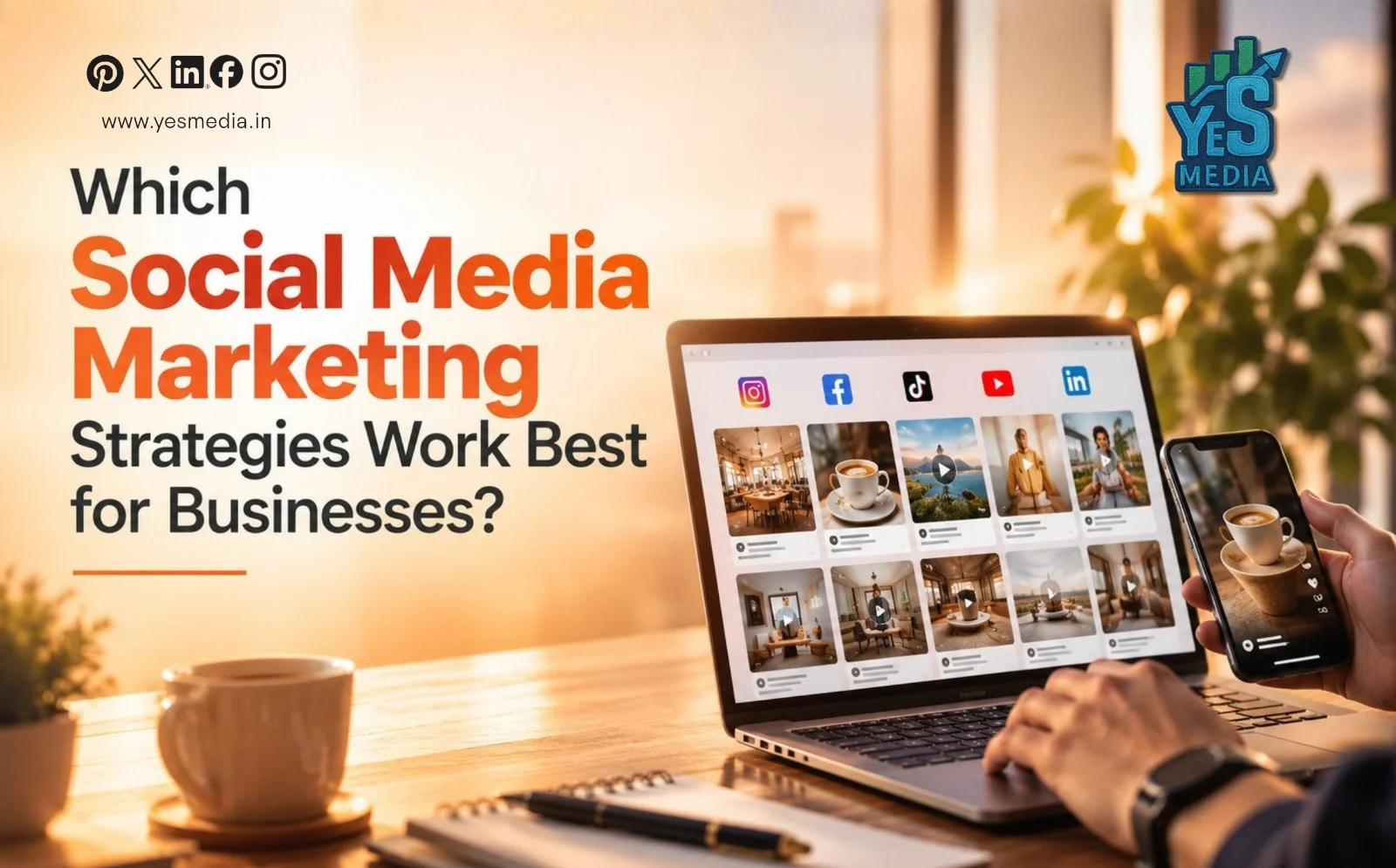
What Is the Best Social Media Marketing Strategy for a Business?
The best approach is a goal-driven social media marketing strategy that connects content, audience needs, business objectives, and measurable actions. Businesses should first identify their target audience and preferred platforms, then build content pillars, maintain a consistent publishing schedule, engage with users, and measure results.
There is no single strategy that works equally well for every business. A B2B software company may prioritize LinkedIn thought leadership, while a local retail business may gain more value from Instagram, Facebook, short-form video, and Google Business Profile content.
Google also recommends creating helpful, reliable, people-first content rather than producing content simply to attract search traffic.
Which Social Media Marketing Strategies Work Best?
The most effective strategies are those that create a clear connection between what people want to know, what the business offers, and what action the customer should take.
Here are the core strategies businesses can use:
- Define measurable business goals such as awareness, website traffic, leads, enquiries, or sales.
- Research the target audience and identify their questions, problems, interests, and preferred platforms.
- Build content pillars covering education, expertise, engagement, proof, and promotion.
- Adapt content to each platform instead of publishing exactly the same post everywhere.
- Encourage conversations through comments, questions, polls, replies, and community interactions.
- Use paid campaigns selectively when organic content alone cannot reach the required audience.
- Track performance and improve continuously using platform analytics and website data.
The important point is that these activities should work together. Posting more often does not automatically mean better marketing results.
1. Start With Clear Business Goals
Before creating posts, decide what the social channel is expected to achieve.
For example, a Tamil Nadu-based service business might use social platforms to increase local awareness and generate enquiries, while an e-commerce brand could focus on product discovery and purchases.
Useful objectives include:
- Increasing brand awareness
- Generating qualified leads
- Driving website traffic
- Increasing enquiries or bookings
- Supporting product launches
- Building customer relationships
- Establishing industry authority
Each objective should have a corresponding metric. For example, lead generation can be measured through enquiries, form submissions, calls, or qualified leads rather than likes alone.
2. Choose Platforms Based on Your Audience
Being active on every platform is not always efficient. Businesses should identify where their potential customers are most likely to discover, evaluate, and discuss relevant products or services.
For B2B companies, LinkedIn can support professional networking, thought leadership, and lead generation. LinkedIn itself recommends maintaining an active, relevant presence and using different content formats to engage professional audiences.
For visually driven businesses, Instagram and YouTube may provide stronger opportunities for demonstrations, videos, tutorials, and visual storytelling.
The strategy should therefore be platform-specific rather than platform-heavy.
How Should Businesses Create Social Media Content?
Accurate business infor
Effective content should answer customer questions, demonstrate expertise, show evidence, or help people make decisions. A practical content mix can include educational posts, industry insights, product or service explanations, customer proof, behind-the-scenes content, FAQs, and carefully targeted promotional posts.
A business should also vary its formats. For example, one topic can become a carousel, short video, text post, infographic, FAQ, or long-form article depending on the platform and audience.
Use Content Pillars
A simple content framework can include:
Content Pillar | Purpose | Example |
Educational | Solve customer questions | “How does SEO work?” |
Expertise | Demonstrate knowledge | Industry analysis or expert tips |
Engagement | Encourage interaction | Polls, questions, opinions |
Social Proof | Build confidence | Reviews, testimonials, results |
Promotional | Generate action | Service offer or consultation |
Brand | Build familiarity | Team, culture, process |
The exact ratio should depend on the business. A highly promotional feed can make users less likely to engage, while a feed containing only educational content may fail to communicate what the company actually offers.
mation, real reviews, updated images and clear service specifics may boost potential clients’ confidence before they contact a firm.
How Can Businesses Turn Social Engagement Into Leads?
Social media becomes commercially useful when the path from content to conversion is clear. Each relevant post should give users an appropriate next step, such as visiting a service page, downloading a resource, requesting a quotation, sending a message, or booking a consultation.
For example, an educational post about website performance can link interested users to a relevant SEO or web-development service page rather than directing everyone to the homepage.
Tracking is equally important. Google Analytics recommends using UTM parameters, tracking parameters added to campaign URLs, to identify the source, medium, campaign, and content associated with website visits.
This helps businesses distinguish traffic from different social platforms and campaigns.
How Can Businesses Measure Social Media Marketing Performance?
Follower count is only one metric, and it does not necessarily indicate business impact. A smaller audience that produces qualified enquiries can be more valuable than a large audience with little commercial activity.
Important metrics include:
- Reach: How many people saw the content.
- Engagement rate: How actively people interacted with it.
- Website traffic: How many users reached the website.
- Leads: How many people expressed genuine interest.
- Conversion rate: How many visitors completed the desired action.
- Cost per lead: How much paid promotion costs for each lead.
- Revenue or assisted conversions: Whether social activity contributes to business outcomes.
Google Analytics separates traffic using dimensions such as source, medium, campaign, and channel, making it possible to evaluate social traffic alongside other acquisition channels.
Businesses should review these metrics regularly and identify which topics, formats, platforms, and campaigns produce the strongest outcomes.
Should Businesses Use Paid Social Media Advertising?
Paid advertising can be useful when a business needs targeted reach, faster testing, product promotion, or lead generation. However, paid campaigns should support a broader marketing strategy rather than compensate for unclear messaging or weak landing pages.
A useful process is to test different audiences, creatives, messages, and calls to action with controlled budgets. Businesses can then move more budget toward combinations that produce qualified results.
The main trade-off is that paid campaigns can generate faster visibility, but the traffic stops when the budget stops. Organic content can build a longer-term presence, but it generally requires consistency and ongoing audience engagement.
How Can a Digital Marketing Agency Improve Social Media Results?
A Digital Marketing Agency can help businesses connect social media activity with broader SEO, content, paid advertising, analytics, and conversion objectives.
At Yes Media – Digital Marketing Agency, we help businesses develop digital marketing strategies around their audience, business goals, content requirements, and measurable outcomes. Based in Tamil Nadu, Yes Media can support businesses that need a structured approach to social media rather than disconnected promotional posts.
The most useful agency approach is not simply increasing the number of posts. It is understanding the business, developing a relevant content strategy, tracking performance, and continuously refining the campaigns based on evidence.
FAQ: Social Media Marketing Strategies
1. How do I choose the right social media platform for my business?
Choose platforms based on where your target customers are active and what type of content your business can consistently produce. For example, LinkedIn can be suitable for B2B services, while Instagram and YouTube can work well for visual or video-led businesses.
2. How long does it take to see results from social media marketing?
There is no fixed timeframe because results depend on the industry, audience, content quality, consistency, competition, and whether paid promotion is used. Businesses should measure progress through relevant indicators such as engagement, website visits, enquiries, leads, and conversions rather than expecting immediate sales.
3. What type of content should a business post on social media?
A strong content mix usually includes educational posts, customer questions, industry insights, product or service information, testimonials, behind-the-scenes content, and promotional posts. The right balance depends on the business and the audience’s stage in the buying journey.
4. Is social media marketing useful for small businesses?
Yes, but small businesses do not need to be active on every platform. A focused strategy built around one or two relevant channels, useful content, regular engagement, and measurable business goals can be more practical than trying to maintain a presence everywhere.
5. Should businesses focus on followers or engagement?
Neither metric should be viewed in isolation. A smaller but relevant audience that generates website visits, enquiries, leads, or sales can be more valuable than a large follower count with little meaningful interaction.
Conclusion
The strongest social strategy is not the one that produces the most posts. It is the one that consistently reaches the right audience, provides useful information, builds trust, encourages meaningful action, and produces measurable business outcomes.
Start with clear goals, choose relevant platforms, create useful content, measure results, and improve the strategy based on actual performance. For businesses in Tamil Nadu and beyond, this approach can make social media a more accountable part of the wider digital marketing plan.
Looking to build a structured social media strategy for your business? Contact Yes Media to discuss your digital marketing goals and create a strategy aligned with your audience and business objectives.